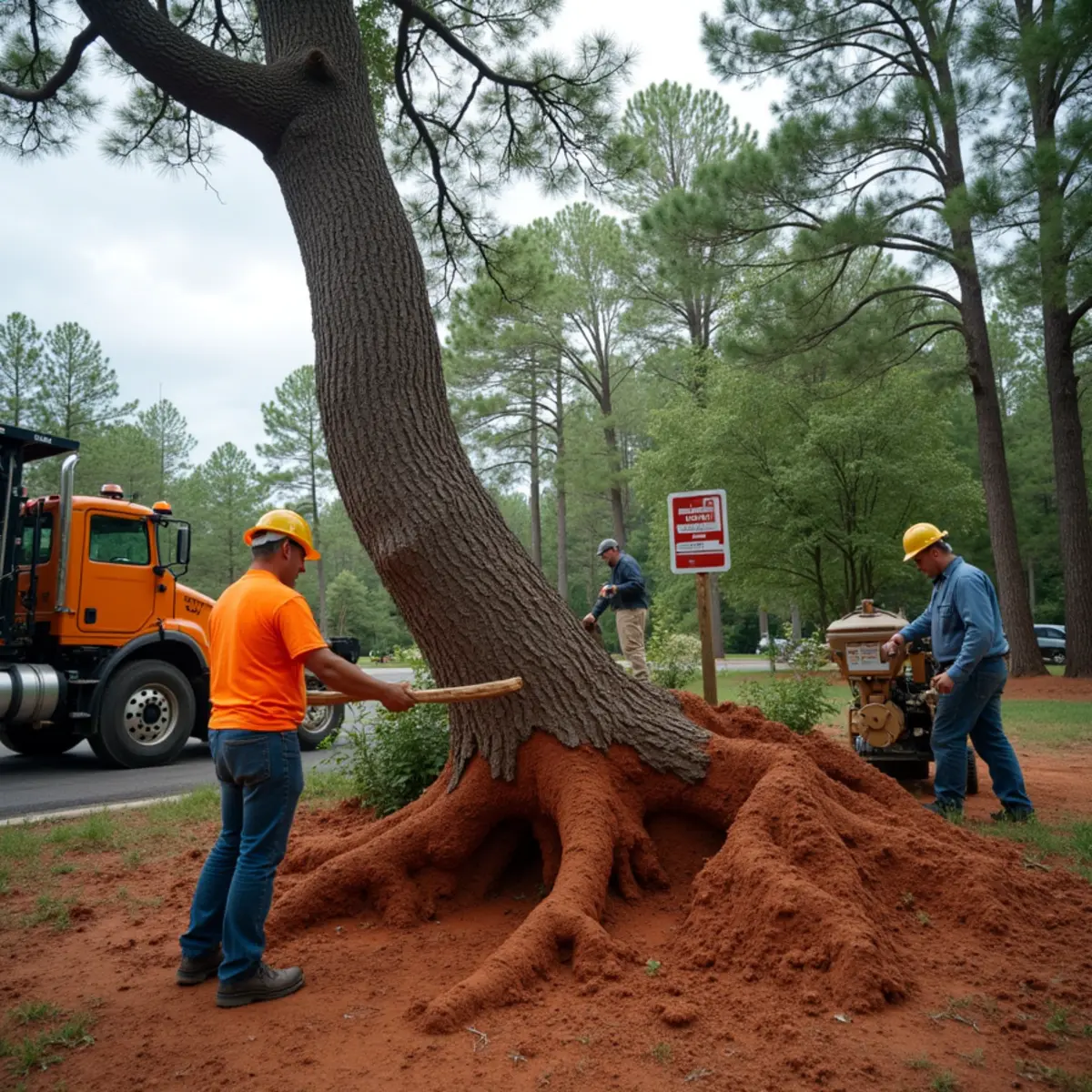
Not every leaning tree is dangerous. Many trees have grown at an angle their whole lives, reaching for light around a building or a taller neighbor, and they are perfectly stable. The trees that worry an arborist are the ones that developed a lean recently, or that show the ground failing around their base. In Charlotte's red clay, those signs can appear fast.
Piedmont soil is a specific challenge. The heavy clay holds water and swells, then dries and shrinks, and after a wet stretch it loses much of its grip on a root plate. A tree that stood through decades of storms can tip in a single saturated week when the clay around its roots turns to slick, unsupportive mud.
Learning to read those signs, in the trunk, the root plate, and the soil, lets you act before a tree comes down on a house, a car, or a person. Here is what to look for in Matthews, Mint Hill, and across the region.
Key Takeaways
- A lean that appeared or worsened suddenly, especially after heavy rain, signals failing root anchorage and is an urgent hazard, not a wait-and-see problem.
- In red clay, look for soil heaving, arc-shaped ground cracks, and a gap opening where the trunk meets the soil on the side away from the lean.
- Saturated Piedmont clay loses its grip on shallow root plates, so many Charlotte trees rotate and fall in the calm days after a storm rather than during it.
- Aging water oaks, shallow-rooted pines, and trees with roots cut by construction carry elevated tip-over risk over any target below.
A new lean is the loudest warning
The most urgent sign is a lean that appeared or worsened suddenly, especially after a storm or a heavy rain. A tree that was vertical last month and is now clearly tilted has lost anchorage, and it is telling you the root system is failing. This is not a wait-and-see situation.
Compare the tree to fixed references: a fence line, the corner of the house, a light pole. If the angle has changed relative to those, treat it as a hazard and keep people away from the fall zone until it can be assessed.
Read the ground at the base
In clay soils, the ground around a failing root plate gives clear evidence. Look for soil heaving, cracking, or a mound rising on the side opposite the lean. As the roots pull up, they push the soil into a low dome, sometimes with a crescent-shaped crack where the plate is hinging.
Water pooling in a fresh depression on the lean side, or exposed roots that used to be buried, both point to a root plate that is lifting. On red clay especially, a gap opening between the trunk base and the soil is a signal that the tree is rotating out of the ground.
- A soil mound or heave on the side away from the lean
- Cracks in the ground in an arc around the trunk
- Roots newly exposed or lifting at the surface
- A visible gap where the trunk meets the soil
Inspect the trunk and root collar
Move your eye up from the ground to the base of the trunk, the root collar. Vertical cracks, bark splitting, or fungal growth like mushrooms and shelf-like conks at the base all suggest decay in the wood that anchors the tree. Decayed roots and a decayed collar cannot hold a lean.
A trunk that flares normally into the ground on the compression side but shows a smooth, unflared, or sunken area on the tension side may be hiding root loss below grade. When the structural roots on the tension side are gone, only the soil is holding the tree, and clay soil is a poor substitute.
Why Charlotte's clay makes it worse
Piedmont red clay behaves very differently from sandy or loamy soil. When dry, it is dense and holds trees well. When saturated after days of rain, it becomes slick and loses shear strength, so a root plate that was firmly held can suddenly rotate. This is why so many Charlotte tree failures cluster in the days after heavy rain rather than during the storm itself.
Clay also encourages shallow, plate-like root systems because roots struggle to penetrate the dense subsoil. A broad but shallow plate is more prone to tipping than a deep root system, which is part of why large willow oaks and pines uproot here rather than snapping.
Trees and sites at higher risk
Some situations deserve extra attention. Trees at the low point of a lot where water collects, trees whose roots were cut for a driveway, patio, or utility trench, and large-canopied species growing in saturated clay all carry elevated risk. Recent construction that disturbed the soil within the root zone is a common trigger for later failure.
Species matters too. Water oaks are notoriously prone to decay and failure as they age, and shallow-rooted pines lift readily from wet clay. If a large specimen of either is leaning over a target, get eyes on it.
- Trees in low, wet spots where clay stays saturated
- Roots recently severed by construction or trenching
- Aging water oaks, which decay from the inside
- Tall pines with shallow plates in soggy ground
When to call a professional
If you see a new or worsening lean, soil heaving, or a lifting root plate, keep people and vehicles out of the potential fall zone and call for an assessment. These are the classic precursors to a whole-tree failure, and once the plate is moving, the tree can come down without further warning.
Our crews assess hazardous leaners across Matthews, Mint Hill, and greater Charlotte, and we can remove a compromised tree safely with proper rigging before it decides for you. Call (855) 615-0568 for a hazard evaluation.
The weather patterns that trigger Charlotte tip-overs
Certain windows in the year concentrate root-plate failures. The classic is a prolonged late-winter or spring wet stretch that keeps the clay saturated for days, followed by a gusty front: the soil has lost its grip and even a moderate wind can rotate the plate. Back-to-back storm systems, common in the Piedmont, compound this because the ground never dries out between them.
Drought followed by sudden heavy rain is a second trigger. Dry clay shrinks and cracks around the roots, then a deluge saturates it quickly, and a marginal tree tips. Watching the forecast for these patterns, and keeping an eye on any tree that already shows a lean or fresh ground movement, tells you when to be most alert around Matthews, Mint Hill, and the rest of the region.
Need help from a Charlotte tree crew?
Free estimates, licensed & insured, 24/7 emergency response.
Related Services & Areas
Frequently Asked Questions
No. Many trees have leaned their whole lives and are stable. The danger sign is a new or worsening lean, especially paired with soil heaving or a lifting root plate. A long-standing lean with normal trunk flare and undisturbed soil is usually fine, but an assessment removes the guesswork.
Piedmont red clay loses much of its grip when saturated. During and after heavy rain the clay turns slick and cannot hold a root plate, so trees often rotate and fall in the calm days following a storm rather than at its peak.
Young, recently leaned trees can sometimes be staked and re-anchored. A mature tree with a failing root plate cannot be saved that way, and its root anchorage will not regrow enough to be safe. For large leaners over a target, removal is usually the responsible choice.
Treat it as urgent. Once the soil is heaving and the plate is rotating, the tree can fail at any time. Keep people and vehicles out of the fall zone and call for a professional assessment right away at (855) 615-0568.
Written & reviewed by
CLT Grapple and Stump Grinding Services
Locally owned and operated in Charlotte since 2018, our crews handle tree removal, grapple hauling, and stump grinding to ANSI A300 pruning and Z133 safety practices. Licensed & insured, 8+ years serving Mecklenburg County and North Carolina. Questions about your property? Call (855) 615-0568 or learn more about us.