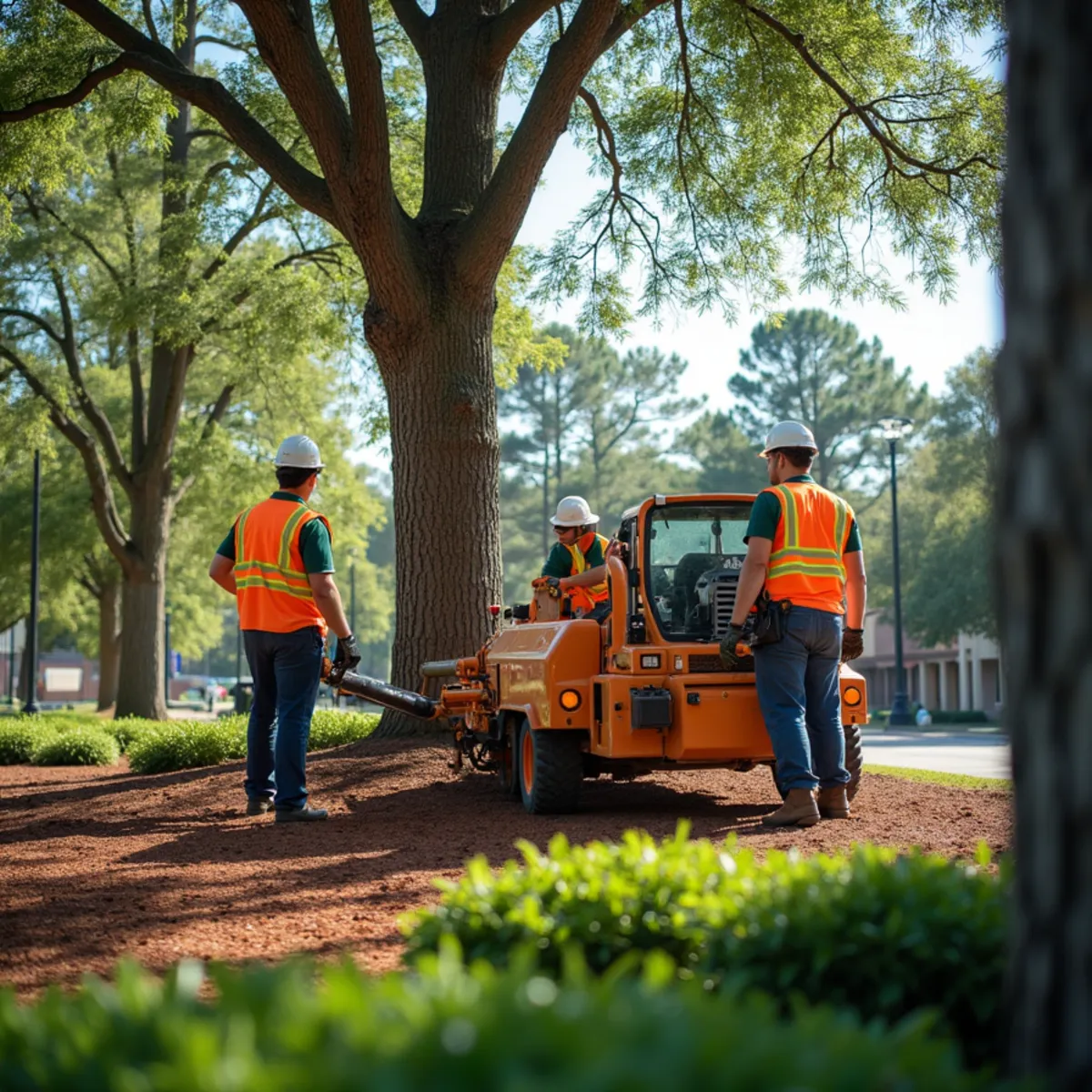
For property managers and commercial owners in Charlotte, trees are both an asset and a liability. Mature landscaping raises property value, attracts tenants and customers, and softens the hard edges of parking lots and office parks. But a neglected tree on commercial property that fails and injures someone, or damages a vehicle or a building, can turn into exactly the kind of liability claim that keeps risk managers up at night.
The distinguishing feature of commercial tree risk is the volume of people and property exposed. A tree over a busy retail parking lot or an office entrance has far more targets, and far more foot and vehicle traffic, than a tree in a quiet backyard. That elevated exposure makes proactive, documented tree management not just good practice but a core part of managing premises liability.
Here is how commercial property owners and managers in Charlotte can approach tree management to protect people, property, and themselves.
Key Takeaways
- Commercial grounds expose far more people and property than a backyard, making proactive, documented tree management a core part of premises liability.
- Owners owe a duty of care, and liability often turns on whether they knew or should have known about a hazard, so inspection history is decisive.
- Documentation is the best protection: dated inspection reports, condition photos, work records, and follow-up demonstrate reasonable care if a claim arises.
- Charlotte's UDO governs tree protection, plantings, and canopy on commercial sites, so hazard work must stay compliant with what you may remove or must replace.
Understanding the liability exposure
Commercial property owners owe a duty of care to the people who come onto their grounds, customers, tenants, employees, and visitors. When it comes to trees, that duty generally includes taking reasonable steps to identify and address hazardous trees that could foreseeably injure someone or damage property. A tree failure that was foreseeable and preventable is the classic premises liability scenario.
The key legal concept is often reasonable care and notice: did the owner know, or should the owner have known, about a hazardous condition, and did they act on it? An owner who never inspects the trees and lets an obviously dead tree loom over a walkway is far more exposed than one who maintains a documented inspection and maintenance program.
Why documentation is your best protection
In commercial risk management, documentation is everything. A written record of regular tree inspections, findings, and the corrective work performed demonstrates that the owner exercised reasonable care, which is exactly what matters if a claim ever arises. Conversely, an absence of any inspection history makes it hard to argue that a failure was unforeseeable.
A sound program creates a paper trail: dated inspection reports, photographs of tree conditions, records of pruning and removals, and follow-up on identified hazards. This record protects the owner and also drives better decisions, because tracking conditions over time reveals which trees are declining before they fail.
- Dated inspection reports for all significant trees on the property
- Photographs documenting tree conditions over time
- Records of all pruning, removal, and hazard-mitigation work
- Documented follow-up on every identified hazard
The elements of a commercial tree program
An effective program is proactive and cyclical rather than reactive. It starts with a professional inventory and assessment of the trees on the property, identifying species, condition, and risk level, and flagging hazards for action. From there, a maintenance schedule addresses routine needs, deadwood removal, structural pruning, clearance over walkways and drives, before they become emergencies.
Priority goes to the highest-exposure areas: trees over parking, entrances, walkways, drive lanes, and building structures. A dead limb over an empty corner of the lot is a lower priority than the same limb over the front door. The program should also include a plan for storm response, because Charlotte's thunderstorms and occasional hurricane remnants will test the grounds.
Coordinating with Charlotte's tree ordinances
Commercial properties in Charlotte operate under the city's tree regulations, including provisions of the Unified Development Ordinance that govern tree protection, required plantings, and canopy on commercial sites. Managing your trees means working within those rules, which can affect what you may remove and what you must preserve or replace.
A knowledgeable tree service helps you navigate this, addressing hazards while keeping the property compliant with local requirements. Removing a protected tree without understanding the ordinance can create a regulatory problem on top of everything else, so compliance is part of responsible commercial management.
Balancing safety, aesthetics, and cost
Commercial owners rightly care about appearance and budget as well as safety. The good news is that these goals align more than they conflict. Well-maintained trees look better, last longer, and fail less, so proactive care that keeps trees healthy and structurally sound serves the property's appearance and its risk profile at once.
Proactive management is also cheaper over time. Scheduled maintenance costs far less than emergency response, and it avoids the far larger costs of a liability claim, property damage, and business disruption when a neglected tree finally fails during business hours. Spending modestly and predictably on prevention beats spending heavily and unpredictably on crises.
Partner with a commercial tree service
Managing trees across a commercial portfolio, or even a single busy site, is best handled by a service equipped for the scale and the liability stakes. That means proper insurance, the equipment to handle large trees and haul commercial volumes of debris, and the ability to respond quickly when a storm hits during business hours.
We provide commercial tree management across Charlotte and Mecklenburg County, from routine inspection and pruning to emergency response and large-scale debris hauling, with the documentation risk managers need. Call (855) 615-0568 to arrange a site assessment for your property.
Everyday clearance and sightline hazards to manage
Beyond the dramatic risk of a whole tree failing, commercial grounds carry quieter, daily tree hazards that generate complaints and claims. Low limbs over drive lanes get struck by delivery trucks and fire apparatus, branches crowding a parking-lot exit or a corner block sightlines and set up collisions, and canopy grown over a light fixture creates a dark pocket that undermines security.
Walkways bring their own issues. Limbs encroaching on a sidewalk push pedestrians off the path, surface roots lift and crack the concrete into trip hazards, and dropped fruit, sap, or wet leaves make a slick surface. A sound maintenance program includes routine clearance pruning to keep these paths, lanes, and sightlines open and safe.
- Raise the canopy over drive lanes for trucks and emergency vehicles
- Keep exits and corners clear so sightlines stay open
- Prune limbs off light fixtures to close dark security gaps
- Maintain accessible clearance and safe surfaces on walkways
Need help from a Charlotte tree crew?
Free estimates, licensed & insured, 24/7 emergency response.
Related Services & Areas
Frequently Asked Questions
Potentially, yes. Owners owe a duty of care to people on their grounds, which generally includes taking reasonable steps to identify and address hazardous trees. Liability often turns on whether the owner knew or should have known about the hazard and failed to act, which is why documented inspections matter.
A written record of inspections, findings, and corrective work demonstrates that the owner exercised reasonable care, which is exactly what matters if a claim arises. It also drives better decisions by tracking declining trees over time. An absence of inspection history is a significant exposure.
A regular, scheduled cycle is best, with more frequent attention to high-exposure trees over parking, entrances, and walkways, and prompt inspections after major storms. The right frequency depends on the site and tree conditions, which a professional inventory and assessment can establish.
Yes. Charlotte's Unified Development Ordinance includes tree protection, planting, and canopy requirements that apply to commercial sites and can affect what you may remove and what you must preserve or replace. Managing your trees means keeping the work compliant with those local rules.

Written & reviewed by
CLT Grapple and Stump Grinding Services
Locally owned and operated in Charlotte since 2018, our crews handle tree removal, grapple hauling, and stump grinding to ANSI A300 pruning and Z133 safety practices. Licensed & insured, 8+ years serving Mecklenburg County and North Carolina. Questions about your property? Call (855) 615-0568 or learn more about us.