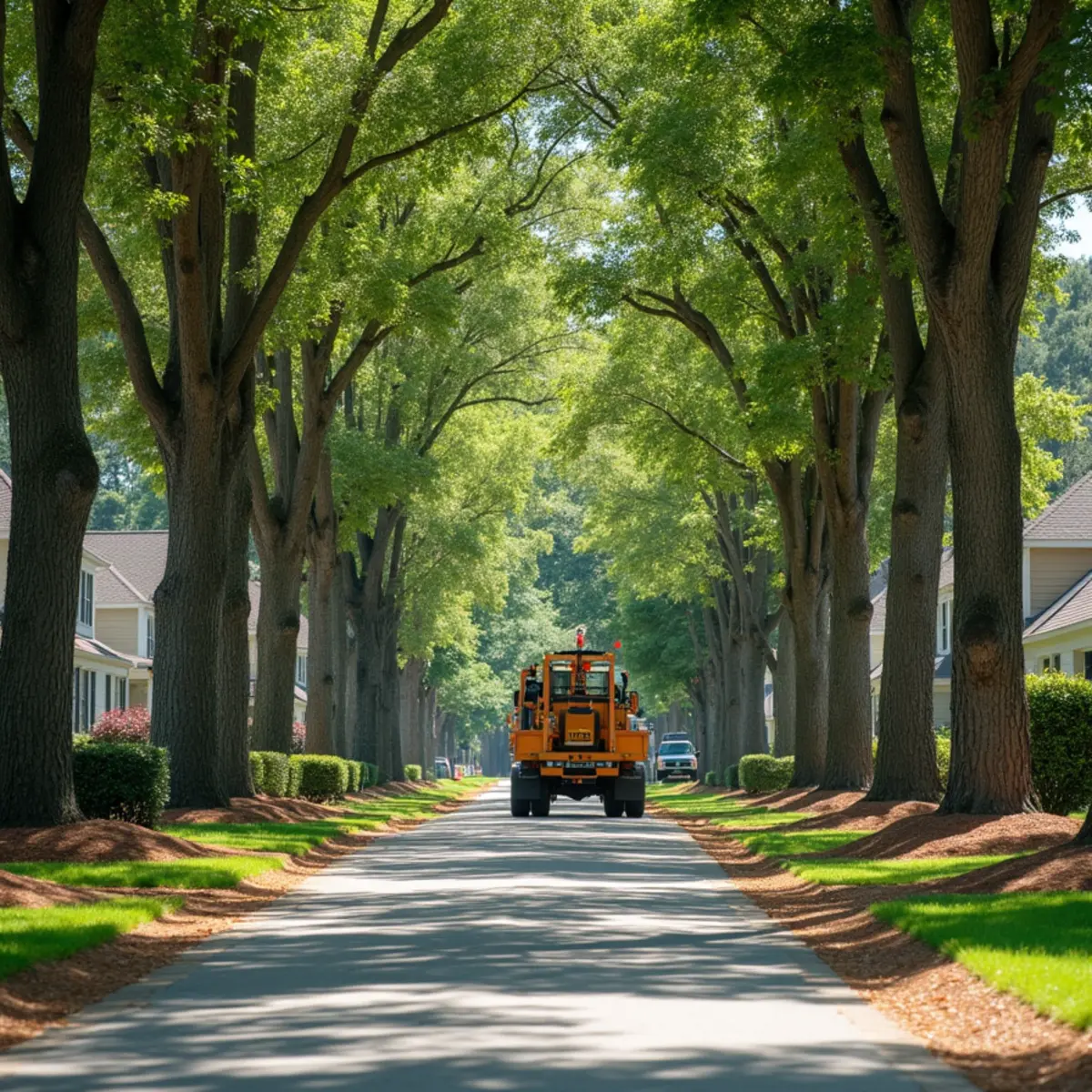
For a homeowners association board, trees are one of the trickiest responsibilities to get right. The mature canopy shading a community's streets and common areas is often its defining feature and a real driver of property values, yet those same trees represent a standing liability and a recurring line item that residents scrutinize. Balancing beauty, safety, and cost is a genuine challenge, and it lands squarely on volunteer boards.
Across North Carolina, from Huntersville to the suburbs of Charlotte, HOAs manage significant tree canopy in common areas, along entrance drives, and in shared green spaces. Doing it well protects residents and the community's finances; doing it poorly invites both hazards and disputes. A clear, consistent approach makes the difference.
Here is a practical framework for HOA boards and property managers to maintain community trees responsibly, covering liability, program design, cost, and the resident relations that make or break tree decisions.
Key Takeaways
- Governing documents control which trees the HOA maintains, typically common areas and entrances, so boards must read the declarations and communicate responsibility clearly.
- An HOA owes a duty of reasonable care for common areas, and a hazardous common-area tree that fails can expose the association to a liability claim.
- A sound program mirrors commercial practice: professional inventory, scheduled pruning and deadwooding, documented inspections, and a storm-response plan.
- Proactive care funded through the budget and reserves is predictable and far cheaper than the emergency removals and claims that deferred maintenance produces.
Clarify who owns and maintains which trees
The first step is often the murkiest: establishing responsibility. In most communities, the HOA maintains trees in common areas, entrances, and shared spaces, while individual homeowners maintain trees on their own lots, but the governing documents control, and they vary. Trees near property lines and along streets can fall into gray areas that cause disputes.
Boards should read their declarations and bylaws carefully to understand exactly which trees the association is responsible for, and communicate that clearly to residents. Ambiguity here is a frequent source of conflict and, worse, of hazardous trees that no one addresses because everyone assumes someone else will.
Understand the association's liability
Like commercial owners, an HOA has a duty of reasonable care for the safety of common areas, which includes the trees it maintains. A hazardous tree in a common area that fails and injures a resident or damages property can expose the association to a liability claim, and boards have a fiduciary duty to manage that risk prudently.
The protective response is the same as for any property owner: regular inspection, documentation, and timely action on identified hazards. An association that maintains a proactive, documented tree program is far better positioned, both in preventing failures and in demonstrating reasonable care, than one that only reacts after something falls.
Build a community tree program
A sound HOA tree program mirrors good commercial practice, scaled to the community. It begins with a professional inventory and risk assessment of the association's trees, then sets a maintenance schedule for routine pruning, deadwood removal, and clearance, with hazards prioritized by risk and exposure.
- Professional inventory and risk assessment of common-area trees
- Scheduled pruning, deadwooding, and clearance over walks and streets
- Documented inspections and records of all work performed
- A storm-response plan for rapid cleanup after severe weather
- A clear process for residents to report tree concerns
Balance canopy preservation with safety
Residents love the community's trees, and boards should too, but sentiment cannot override safety. The goal is not to remove trees, but to keep them healthy and structurally sound so they can be preserved safely for as long as possible. Skilled pruning and timely care let a community keep its canopy while managing risk, which is the outcome everyone actually wants.
When a tree is genuinely hazardous, decayed, dead, or structurally failing over homes, streets, or gathering areas, removal is the responsible choice even if residents are attached to it. Handling those decisions transparently, with a professional assessment to back them up, helps residents accept a necessary removal, and replanting maintains the canopy for the future.
Manage cost and resident expectations
Tree care is a real budget item, and boards answer to residents for every dollar. The most cost-effective approach is proactive maintenance funded through the regular budget and reserves, which is predictable and far cheaper than the emergency removals and liability claims that neglect eventually produces. Deferring tree care to save money usually costs more later.
Communication is half the battle. Residents accept tree spending and even removals far more readily when the board explains the reasoning, shares professional assessments, and shows a consistent, fair program applied to everyone. Surprise removals and opaque decisions, by contrast, generate the disputes that consume board meetings.
Storm readiness for the whole community
Charlotte-area weather, summer thunderstorms, ice storms, and the occasional hurricane remnant, will test an HOA's trees, sometimes all at once across the whole community. A board that has done proactive work and has a storm-response relationship in place will see less damage and faster cleanup than one caught flat-footed, when every crew in the region is booked.
Establishing a relationship with a tree service before the storm means priority response and coordinated cleanup when it matters. Grapple trucks and commercial hauling make short work of the volume of debris a community generates in a major event, restoring normalcy quickly for residents.
Partner on a community tree program
HOA tree management rewards a steady, professional partnership: someone who knows the community's trees, maintains the documentation the board needs, handles routine care predictably, and responds fast when storms hit. That continuity serves residents, protects the association, and preserves the canopy that makes the community what it is.
We work with HOA boards and property managers across Huntersville, Charlotte, and the surrounding communities on inventory, scheduled maintenance, hazard removal, and storm response, with the documentation and hauling capacity community-scale work requires. Call (855) 615-0568 to build a program for your community.
When a tree crosses the HOA and homeowner line
Some of the thorniest tree decisions involve a tree on one party's side that threatens the other's. A homeowner's declining oak may loom over a common-area sidewalk, or an association tree may drop limbs onto a resident's roof. Because responsibility follows the governing documents and the tree's location, these situations stall when each side assumes the other will act, and the hazard sits unaddressed.
The board's job is to resolve them on the facts rather than let them fester. Get a professional assessment to establish the hazard and whose tree it is, put the finding and the request to act in writing, and follow up. Documented notice matters here for the same reason it does throughout tree liability: it shows the association acted reasonably, and it protects the community if the tree later fails.
Need help from a Charlotte tree crew?
Free estimates, licensed & insured, 24/7 emergency response.
Related Services & Areas
Frequently Asked Questions
It depends on the governing documents, but typically the HOA maintains trees in common areas, entrances, and shared spaces, while homeowners maintain trees on their own lots. Boards should read their declarations carefully and communicate responsibility clearly, since ambiguity causes disputes and neglected hazards.
Yes, an association has a duty of reasonable care for common areas, including its trees, and boards have a fiduciary duty to manage that risk. A hazardous common-area tree that fails can expose the HOA to liability, which is why regular documented inspections and timely action are essential.
Through proactive care: professional inventory, scheduled pruning and deadwooding, and timely attention to hazards. The goal is to keep trees healthy and structurally sound so they can be preserved safely as long as possible, removing only the genuinely hazardous ones and replanting to sustain the canopy.
Transparency and evidence. Share the professional assessment showing why the tree is hazardous, explain the liability and safety reasoning, apply the program consistently to everyone, and pair removals with replanting. Residents accept necessary removals far more readily when the decision is clearly justified.
Written & reviewed by
CLT Grapple and Stump Grinding Services
Locally owned and operated in Charlotte since 2018, our crews handle tree removal, grapple hauling, and stump grinding to ANSI A300 pruning and Z133 safety practices. Licensed & insured, 8+ years serving Mecklenburg County and North Carolina. Questions about your property? Call (855) 615-0568 or learn more about us.