The most dangerous trees are often the ones that look fine. A tree can be green and full of leaves while its trunk is slowly hollowing out from the inside, and by the time the decay is obvious, the tree may already be a serious hazard. Internal wood decay is the hidden condition behind many of the whole-tree and large-limb failures that damage homes across the Piedmont.
The reassuring part is that trees rarely rot silently. Decay leaves external clues, if you know what to look for, and reading those clues lets you judge a tree's condition without cutting it open. For homeowners in Belmont, Gaston County, and greater Charlotte, learning these signs is one of the most useful tree-safety skills there is.
Here is how internal decay works, the signs it leaves on the outside, and how to think about when a decayed tree crosses the line into dangerous.
Key Takeaways
- A tree can hold full green foliage while its heartwood hollows out, because the living tissue is only a thin layer under the bark, so looks are not safety.
- Shelf-like fungal conks are the clearest sign of internal rot, and conks at the trunk base or root flare point to decay in the anchoring structure.
- Cavities, oozing vertical cracks, canopy dieback, and a hollow drum-like sound when tapped are added clues that decay is advancing.
- Danger depends on how much sound wood remains, where the decay sits, and what the tree could hit, so location and target matter as much as the rot itself.
How trees rot from the inside
Wood decay is caused by fungi that enter through wounds, broken limbs, pruning cuts, storm damage, or root injuries, and slowly consume the wood inside the trunk and major limbs. The tree's living tissue is a thin layer just under the bark, so a tree can keep growing leaves while the dead heartwood at its core is being eaten away.
As decay advances, it hollows the trunk and weakens the wood's ability to resist bending and breaking. A tree can tolerate a surprising amount of internal decay and still stand, but there is a threshold beyond which the remaining shell of sound wood can no longer hold the tree up. Reading the external signs is how you estimate where a tree sits relative to that threshold.
Fungal conks: the clearest warning
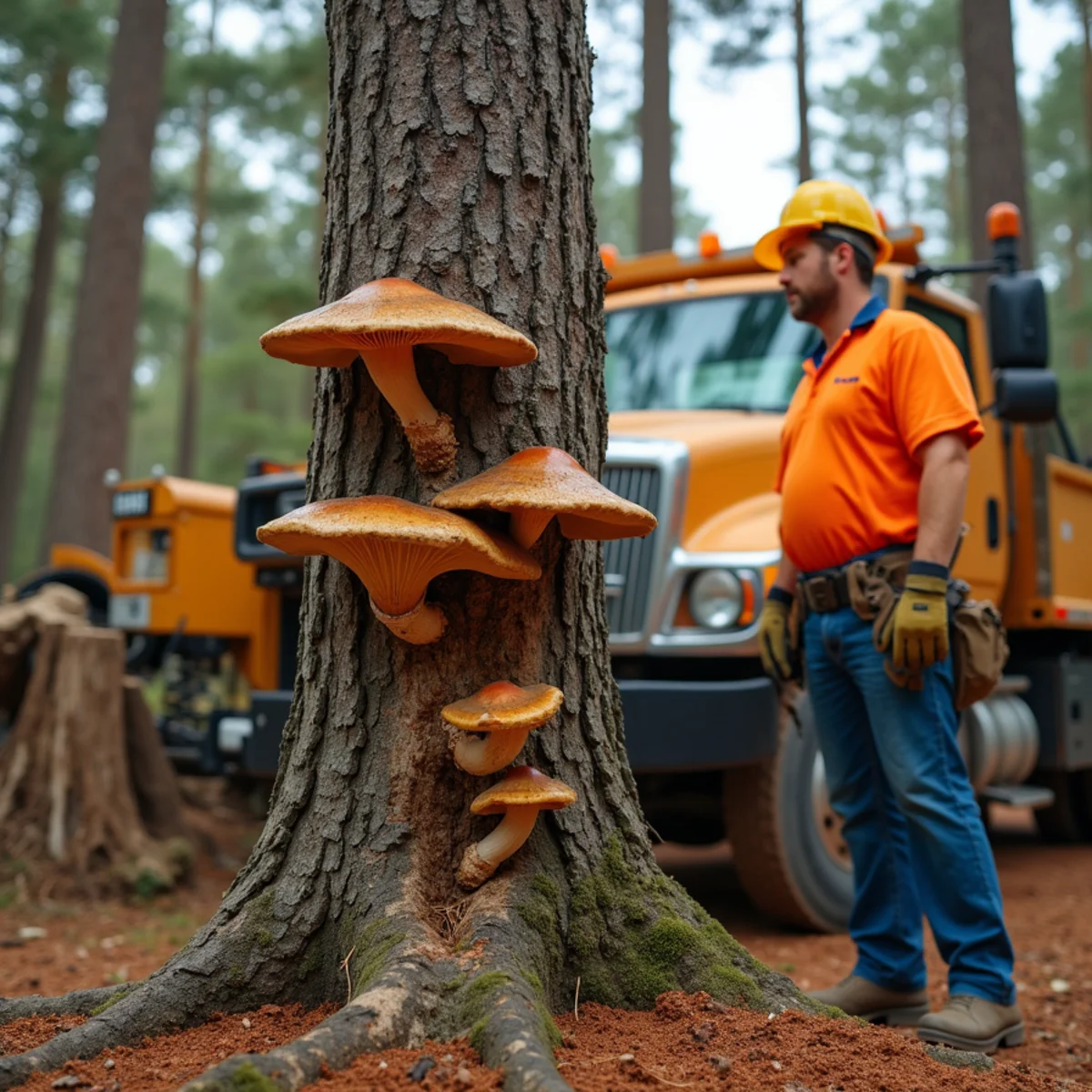
The single most telling sign of internal decay is the presence of fungal fruiting bodies on the trunk, limbs, or roots. These are the mushrooms and, especially, the shelf-like or bracket-shaped growths called conks that emerge from the bark. A conk on a trunk is the visible fruit of a fungus that is decaying the wood inside, and it is a strong signal that significant internal rot is present.
Conks at the base of the trunk or on the root flare are particularly concerning, because they point to decay in the roots and lower trunk, the structure that anchors and supports the entire tree. Not every conk means imminent failure, but any conk warrants a professional look, because it tells you the decay process is well underway.
- Shelf or bracket-shaped conks growing from the trunk or limbs
- Mushrooms at the base of the tree or over the root zone
- Conks on the root flare, indicating decay in the anchoring roots
- Soft, punky, or crumbling wood where you press the trunk
Cavities, cracks, and hollow sounds
Visible cavities and holes in the trunk are obvious signs that decay has opened the wood, though the size of the opening does not reliably tell you how much is hollow inside; a small hole can lead to a large internal cavity. Vertical cracks and seams, especially ones that ooze or show discolored, wet wood, can indicate internal decay or structural weakness.
Tapping the trunk with a mallet and listening is a rough field test: a solid tree gives a dull thud, while a hollow one can sound noticeably more resonant or drum-like. This is not precise, and a proper evaluation may use specialized tools, but a hollow sound over a large area is a reason to be concerned.
Other clues in the canopy and base
Decay often shows up elsewhere on the tree. Dieback in the upper canopy, branches that leaf out late or not at all, can signal root and lower-trunk decay interfering with the tree's plumbing. A general decline in vigor, sparse foliage, and smaller-than-normal leaves can accompany advancing internal rot.
At the base, look for carpenter ants or other insects, which are often attracted to already-decaying wood, sawdust-like frass, and areas where the bark is loose or falling away over soft wood. These secondary signs, combined with conks or cavities, paint a clearer picture of a tree in structural decline.
When decay becomes dangerous
The critical question is not whether a tree has some decay, many mature trees do, but whether enough sound wood remains to hold it up, especially over a target. Arborists weigh the amount and location of decay against the load: a hollow trunk with a thin shell of sound wood, decay at the base or a major union, or a decayed tree leaning over a house all point toward removal.
Location and target matter enormously. Extensive decay in a tree standing alone in a field is a low priority; the same decay in a tree over your roof or a play area is urgent. This judgment is exactly where a professional assessment earns its keep, because the external signs must be weighed together, not in isolation.
Get a decayed tree professionally assessed
If you spot conks, cavities, hollow sounds, or canopy dieback on a mature tree, especially one within reach of your home, have it evaluated rather than guessing. A qualified assessment weighs the decay, the remaining sound wood, and the target to determine whether the tree can be retained, pruned, or must be removed.
We assess and remove decayed, hazardous trees across Belmont, Gaston County, and greater Charlotte, with the rigging expertise that compromised, unpredictable wood demands. Call (855) 615-0568 for an evaluation before hidden decay makes the decision for you.
How professionals measure hidden decay
When the external signs raise concern but the tree might be worth keeping, an arborist can move beyond tapping and looking to actually gauge how much sound wood remains. A simple probe or a small-diameter drill can reveal where solid wood gives way to soft, punky decay behind a cavity or conk. More advanced tools measure it without cutting the tree open.
Two are common in the field: a resistance-drilling device that records how strongly the wood resists a fine needle as it advances, mapping the soft zones, and sonic tomography, which sends sound waves through the trunk to image internal decay. Weighed against the load the trunk must carry and what stands below it, these readings turn a judgment call into a measured decision to retain, reduce, or remove the tree.
- A probe or fine drill checks for soft wood behind a conk or cavity
- Resistance drilling maps solid versus decayed wood along a path
- Sonic tomography images internal decay without cutting the tree
- Readings are weighed against the trunk's load and the target below
Need help from a Charlotte tree crew?
Free estimates, licensed & insured, 24/7 emergency response.
Related Services & Areas
Frequently Asked Questions
Yes. A tree can hold full, green foliage while its trunk hollows out from internal decay, because the living tissue is a thin layer under the bark. Many serious failures come from trees that looked fine. External clues like conks and cavities reveal the hidden condition.
Conks are the fruiting bodies of wood-decay fungi, and their presence signals significant internal rot in the wood behind them. Conks on the trunk base or root flare are especially concerning because they indicate decay in the structure that anchors the tree. Any conk warrants a professional look.
Not always. Trees tolerate considerable internal decay and still stand, as long as enough sound wood remains in the shell. The danger depends on how much sound wood is left, where the decay is, and what the tree could hit if it failed. An arborist weighs these factors together.
External signs include conks, cavities, cracks, canopy dieback, and soft or crumbling wood. Tapping the trunk and hearing a hollow, drum-like sound over a large area is a rough clue. A precise evaluation may use specialized tools, so have a suspect tree professionally assessed.
Written & reviewed by
CLT Grapple and Stump Grinding Services
Locally owned and operated in Charlotte since 2018, our crews handle tree removal, grapple hauling, and stump grinding to ANSI A300 pruning and Z133 safety practices. Licensed & insured, 8+ years serving Mecklenburg County and North Carolina. Questions about your property? Call (855) 615-0568 or learn more about us.