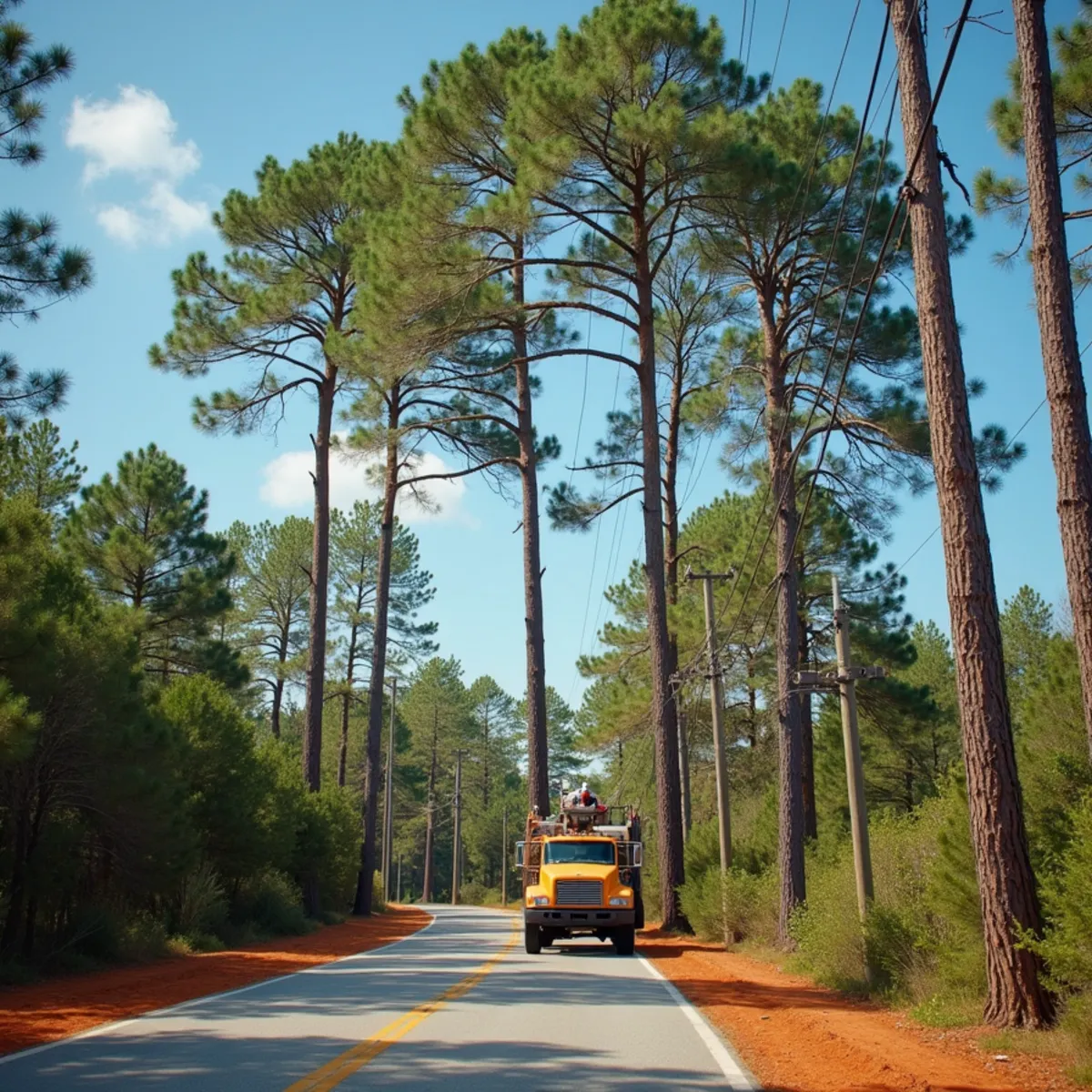
Loblolly pines are the workhorse tree of the North Carolina landscape, fast-growing, tall, and everywhere, from managed timber stands to the edges of suburban yards. That same fast growth makes them one of the most common tree species to threaten power lines, and the combination of a hundred-foot pine and an energized Duke Energy conductor is genuinely dangerous.
When a loblolly near a line dies, leans, or drops a top in a storm, the result is often an outage, and sometimes a fire or a live line on the ground. Managing these trees before that happens protects your power, your property, and your safety. But it is not do-it-yourself work, because anything near an energized line carries the risk of electrocution.
Here is what makes loblolly pines and power lines such a hazardous pairing in Monroe, the Charlotte suburbs, and rural Union County, and how the work is done the right way.
Key Takeaways
- Loblolly pines grow fast to eighty or a hundred-plus feet with top-heavy crowns, so a harmless sapling can tower over the power lines within two decades.
- Pines threaten lines by whole-tree fall, snapped tops and limbs, and growth into direct contact that arcs, causing outages or even fire.
- Tree work near an energized line risks electrocution through arcing without contact; it is never DIY, and a limb on a line means call Duke Energy and stay back.
- Duke Energy maintains its main rights-of-way, but the service drop to your house and trees on your lot are generally your responsibility to manage safely.
Why loblolly pines outgrow their space
Loblolly pines grow fast and grow tall, commonly reaching eighty to a hundred feet or more, with the bulk of their canopy high on a slender trunk. A pine that was a harmless sapling when a house was built can tower over the power lines two decades later. Their rapid height gain is exactly why they so often end up in conflict with overhead utilities.
Because so much of a loblolly's weight and foliage sits high up, a failure aloft, a snapped top or a leaning trunk, drops heavy material directly onto whatever is below, including lines. A tree that has grown into the space around a conductor is a standing hazard waiting for wind, ice, or decay to trigger it.
How pines threaten the lines
Pines endanger power lines in several ways. A whole tree can fall across the line in a storm. A single limb or the top can break and land on the conductor. And even without falling, a tree growing into contact with a line can arc, cause outages, or start a fire, particularly in dry conditions.
Loblolly pines add specific risks. They are prone to snapping in ice storms because of their needled, top-heavy crowns, and they are targets for the southern pine beetle, which can kill a line-side pine and turn it into a dead, brittle hazard practically overnight. A dead pine over a line is a high-priority removal.
- Whole-tree failure across the line in wind or saturated soil
- Snapped tops and limbs falling onto conductors
- Growth into contact, causing arcing, outages, or fire
- Ice-storm snapping and beetle-killed dead pines over lines
The critical safety rule: never work near a live line
This cannot be overstated. Any tree work near a power line risks electrocution, and electricity can arc to a person, a tool, or a branch that gets too close, without direct contact. Homeowners are seriously injured or killed every year attempting to trim trees near lines. This is never a do-it-yourself job.
If a tree or limb is already on a line, or a line is down, treat the line as live no matter what, stay well back, keep others away, and call Duke Energy. Do not touch the tree, do not move the limb, and do not approach. The utility de-energizes and clears the line before any tree work begins.
Who is responsible for which trees
Responsibility depends on the line. Duke Energy maintains clearance along its distribution and transmission rights-of-way and manages vegetation there, which is why you see utility line-clearance crews trimming along the main lines. But the service drop, the smaller line running from the pole to your house, and trees on your own property are generally the homeowner's responsibility.
That gray area, a private pine threatening the service line to your home, is exactly where owners get into trouble trying to handle it themselves. The safe path is a professional tree service that coordinates with the utility, arranges de-energizing if needed, and does the work with proper training and equipment.
How the work is done safely
Professional removal of a pine near a line is a coordinated, methodical process. The crew assesses the tree, the line, and the fall zone, and arranges for the utility to de-energize or provide clearance when the tree is close enough to require it. The pine is then dismantled in controlled sections and rigged down, rather than felled, so no part swings into the line.
Grapple trucks and proper rigging keep the heavy pine wood under control from cut to ground. This combination of utility coordination, trained personnel, and the right equipment is what makes a dangerous job safe, and it is entirely beyond the scope of homeowner tools.
Protect your power and your safety
If you have tall loblolly pines leaning toward or growing into the lines serving your home, do not wait for a storm to force the issue, and do not attempt it yourself. Have the trees assessed and managed before they fail, in the calm, not the crisis.
We handle utility-adjacent pine removals across Monroe, Union County, and greater Charlotte, coordinating with Duke Energy where the line requires it. Call (855) 615-0568 to address a line-side pine safely.
Plant the right tree so lines stay clear
The cheapest way to solve a line conflict is to never create one. Tall-growing species like loblolly pine simply do not belong under or beside overhead conductors, yet they are planted there constantly because no one pictures the mature height. Before you plant, look up: if a wire runs overhead, choose a small, low-mature-height tree or shrub for that spot and save the big shade trees for the open yard.
For pines and other tall trees already in place, the practical rule of thumb is that a tree should stand far enough from a line that its full height could fall without reaching the wire. Where that is not possible and the tree threatens the service drop, managed removal in the calm beats an emergency during a storm.
- Never plant tall species under or beside overhead lines
- Choose low-mature-height trees and shrubs for spots beneath wires
- Site big shade trees so their full height cannot reach a conductor
- Have already-tall line-side pines assessed before a storm forces the issue
Need help from a Charlotte tree crew?
Free estimates, licensed & insured, 24/7 emergency response.
Related Services & Areas
Frequently Asked Questions
No. Electricity can arc to a person, tool, or branch that gets too close, without direct contact, and homeowners are injured or killed doing this every year. Tree work near power lines is never a do-it-yourself job. If a limb is on a line, call Duke Energy and stay well back.
Duke Energy manages vegetation along its main distribution and transmission rights-of-way. But the service drop to your house and trees on your own property are generally your responsibility. A professional tree service can handle those and coordinate with the utility when the line requires clearance.
They grow fast and tall, often eighty to a hundred feet, with heavy, top-heavy crowns that snap in ice storms and drop tops onto lines. They are also vulnerable to the southern pine beetle, which can kill a line-side pine quickly, leaving a dead, brittle hazard.
Treat the line as live regardless of appearances, keep everyone well back, and call Duke Energy immediately. Do not touch the tree or the line. The utility de-energizes and clears the line before any tree removal work can safely begin.

Written & reviewed by
CLT Grapple and Stump Grinding Services
Locally owned and operated in Charlotte since 2018, our crews handle tree removal, grapple hauling, and stump grinding to ANSI A300 pruning and Z133 safety practices. Licensed & insured, 8+ years serving Mecklenburg County and North Carolina. Questions about your property? Call (855) 615-0568 or learn more about us.