Few tree problems in North Carolina move as fast or spread as aggressively as the southern pine beetle. This tiny insect, no bigger than a grain of rice, can kill a healthy pine in a matter of weeks and then jump to its neighbors, wiping out a stand of loblolly or shortleaf pines in a single season. For property owners with pines in Mint Hill, the Charlotte suburbs, or the wider Piedmont, early recognition is the whole game.
Unlike slow declines you can watch and plan around, a southern pine beetle infestation is a race. By the time the crown turns brown, the beetles that killed that tree have often already moved on to the next. Knowing the warning signs and acting immediately is the only way to protect the rest of your pines.
Here is how to identify an attack, understand why it spreads so fast, and respond before a single infested tree becomes a lost grove.
Key Takeaways
- Southern pine beetles can kill a healthy loblolly or shortleaf pine in weeks, then jump to its neighbors, so early recognition is the whole game.
- The clearest sign is popcorn-like pitch tubes on the bark, alongside a crown fading green to yellow to red-brown and S-shaped galleries beneath the bark.
- Beetles release pheromones that mass-attack a stand, and multiple generations per warm NC season let a small spot double or triple within weeks.
- Once a pine is under active attack it cannot be saved; prompt removal of infested trees, often with an adjacent buffer, is the proven response.
Know your pines and your risk
North Carolina's Piedmont is full of loblolly pines, with shortleaf and other yellow pines mixed in, and these are exactly the trees the southern pine beetle targets. Dense stands of same-age pines, stressed by drought, crowding, storm damage, or lightning, are especially vulnerable, because stressed trees have weaker defenses.
The beetle populations rise and fall in cycles, and during an outbreak year they can spread explosively. If you have pines, and much of the region does, it pays to know what an attack looks like so you can catch it in the narrow window when action still helps.
The warning signs, from top to bottom
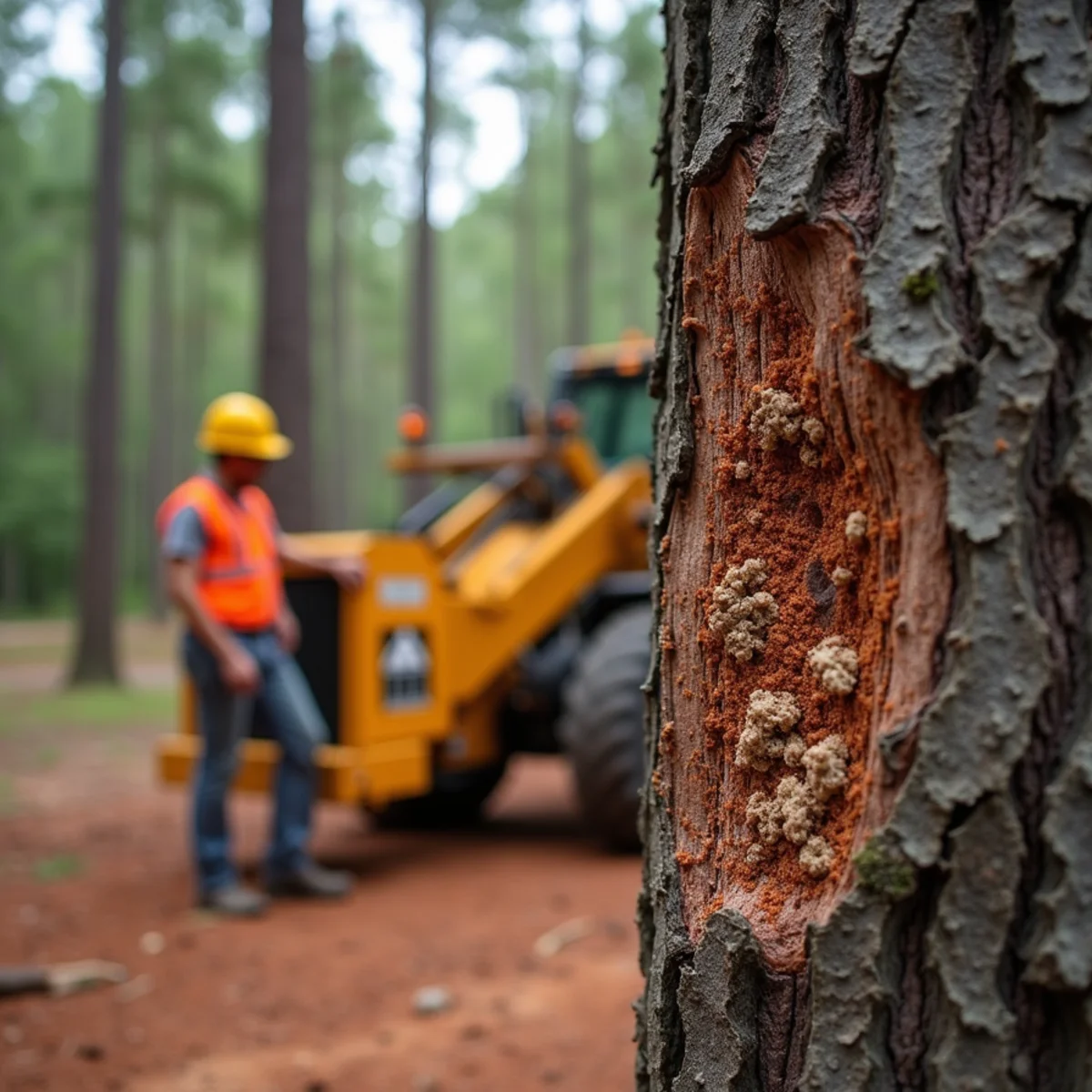
Southern pine beetle damage shows up in a recognizable sequence. The single most telling sign is popcorn-sized blobs of resin called pitch tubes on the bark, where the tree tried to push the invading beetles out with sap. Look also at the crown color and the bark surface.
- Pitch tubes: small popcorn-like lumps of resin on the trunk bark
- Fading crown: needles turning from green to yellow, then red-brown
- S-shaped galleries: winding tunnels under the bark if you peel a patch
- Boring dust: fine reddish sawdust in bark crevices and at the base
- Woodpecker activity: birds flaking bark to reach the larvae
- Spread pattern: dying trees appearing in an expanding patch, not scattered
Why it spreads so fast
The southern pine beetle's danger is its speed and its numbers. The beetles release pheromones that attract more beetles to the same area, so an attack concentrates force on a stand and overwhelms the trees' defenses. Multiple generations can occur in a single warm North Carolina season, compounding the population.
As one tree dies, the beetles emerge and fly to the nearest healthy pines, usually the immediate neighbors, so infestations grow outward as a spreading spot. This is why a single fading tree is an emergency for the whole grove, not an isolated loss you can ignore.
Warm weather accelerates everything. In the Piedmont's long, hot summers the beetles can complete a generation in just a few weeks, so a spot that looks manageable in June can double or triple by August. Cold winters slow the beetles down but rarely wipe them out, which is why outbreaks that begin one season can carry into the next if the initial infestation is not cut out promptly.
Why rapid removal is the response
Once a pine is under active attack, it cannot be saved, and leaving it standing endangers every pine around it, because it is a beetle nursery producing the next wave. The established management response is prompt removal of infested trees, and often a buffer of the immediately adjacent trees, to break the spread before the beetles emerge.
Timing is critical. Removing infested trees quickly, while the beetles are still under the bark, and handling the wood properly, keeps the population from dispersing. Waiting even a few weeks can mean the difference between losing one tree and losing a dozen.
What not to do
Do not assume a single browning pine is just a random dead tree, and do not wait to see if it recovers, because it will not, and the delay costs you the neighbors. Do not leave felled infested logs piled on the property, where beetles can still emerge; the wood needs proper handling and prompt removal.
And do not attempt to fell large, dead, brittle pines yourself. Beetle-killed pines dry, weaken, and become dangerously unpredictable to cut, prone to snapping and barber-chairing. This is professional removal work.
Get infested pines assessed and removed fast
If you see pitch tubes, a fading crown, or a spreading patch of dying pines, treat it as time-sensitive. A prompt professional assessment confirms whether it is southern pine beetle and identifies which trees must come out to protect the rest.
We remove diseased and beetle-killed pines quickly and safely across Mint Hill and the greater Charlotte area, with grapple trucks to haul the wood off before it becomes a source of reinfestation. For guidance on large-scale forest concerns, the North Carolina Forest Service is also a valuable resource. Call (855) 615-0568 to act before the beetles do.
Can you keep your pines from being attacked?
You cannot spray your way out of a southern pine beetle outbreak, but you can make your pines a less inviting target, because the beetles concentrate on stressed, crowded trees. Keeping pines vigorous is the real defense: relieving overcrowding so trees are not competing for water and light, avoiding root and trunk damage during construction, and watering during severe drought all help a pine mount its natural resin defense.
Dense, same-age pine stands are the highest-risk setting, so thinning them before an outbreak reduces both the stress on the trees and the beetle's ability to jump from one to the next. If you own a wooded pine tract around Mint Hill or the wider Piedmont, planning that thinning with a professional, and knowing what an early attack looks like, is far cheaper than losing a grove.
Need help from a Charlotte tree crew?
Free estimates, licensed & insured, 24/7 emergency response.
Related Services & Areas
Frequently Asked Questions
Very fast. A healthy pine can be killed in a matter of weeks once beetles successfully attack it, and by the time the crown turns brown the beetles have often already moved to neighboring trees. That speed is why early recognition and rapid removal are essential.
Pitch tubes are small, popcorn-like blobs of resin on the bark where the tree tried to flush out invading beetles with sap. They are one of the clearest signs of a bark beetle attack. Combined with a fading crown, they signal an active infestation that needs prompt action.
No. Once a pine is under active southern pine beetle attack it cannot be saved, and leaving it standing endangers surrounding pines by producing the next generation of beetles. The proven response is prompt removal of infested trees to stop the spread.
Beetles emerging from a dying tree fly straight to the nearest healthy pines, so infestations spread outward as a patch. Removing a buffer of adjacent trees along with the infested ones helps break that spread. A professional assessment determines which trees must come out.

Written & reviewed by
CLT Grapple and Stump Grinding Services
Locally owned and operated in Charlotte since 2018, our crews handle tree removal, grapple hauling, and stump grinding to ANSI A300 pruning and Z133 safety practices. Licensed & insured, 8+ years serving Mecklenburg County and North Carolina. Questions about your property? Call (855) 615-0568 or learn more about us.