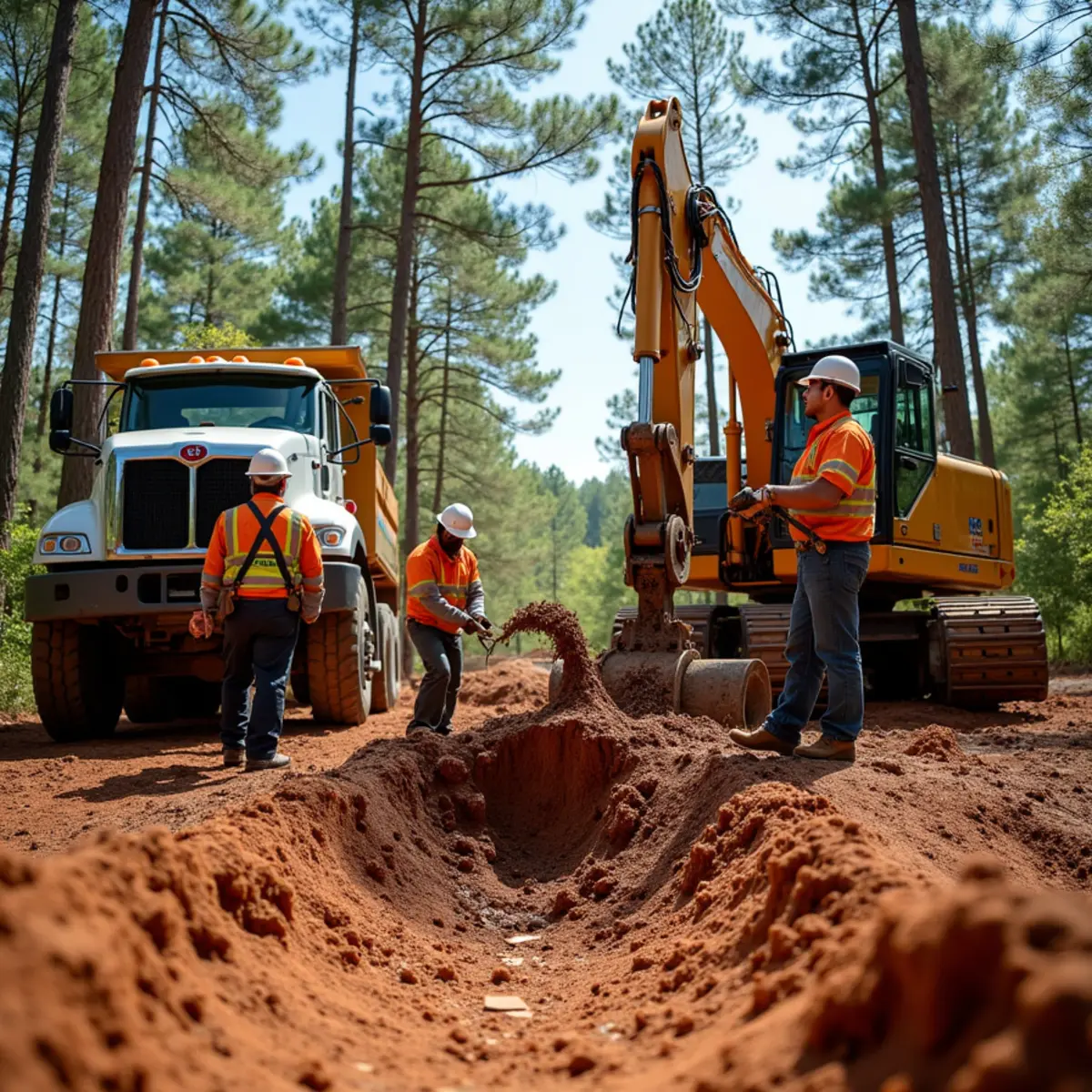
Once a tree is down, the stump remains, and it is more stubborn than most homeowners expect. In North Carolina's red clay, you have two realistic paths: grind it down with a stump grinder, or excavate it whole with heavy equipment. Each has its place, and choosing wrong wastes money or leaves you unable to do what you planned with the space.
The right choice depends on what happens next on that spot. Planting a new tree, pouring a patio, running a fence, or simply reclaiming lawn each point toward a different method. Clay soil adds its own wrinkles, because it is dense, holds moisture, and does not backfill or settle the way looser soils do.
Here is an honest comparison, grounded in how these methods actually perform in Gastonia, Charlotte, and the surrounding Piedmont clay, so you can make the call with clear eyes.
Key Takeaways
- Grinding chews the stump and flare into mulch four to twelve inches below grade but leaves the major roots to decay, which is fine for lawn and most landscaping.
- Full excavation removes the entire stump and root ball but leaves a large hole and heavy, sticky clay spoil that is awkward and costly to haul away.
- As planning estimates, grinding runs about $100 to $400 per stump versus roughly $250 to $800 or more for excavation, so grinding wins most residential jobs.
- Reserve excavation for foundations, driveways, or replanting in the same hole, where leftover wood would interfere with compaction or cause settling.
What stump grinding actually does
A stump grinder is a machine with a rotating, carbide-toothed wheel that chews the stump into chips, working from the top down and typically reaching four to twelve inches below grade. It reduces the visible stump and the flare to mulch, which is left in the hole or hauled away.
Grinding does not remove the entire root system. The major roots remain in the soil, where they slowly decay over several years. For most purposes, lawn, most landscaping, general tidiness, that is completely fine, because the remaining roots pose no problem as they break down.
What full excavation involves
Excavation, sometimes called stump removal, uses an excavator or backhoe to dig out the entire stump and the major root ball. It leaves a large hole and a much bigger disturbance, and in clay it produces heavy, sticky spoil that is awkward to handle and dispose of.
The upside is total removal: no wood left behind, which matters for certain construction. The downsides are cost, mess, and a substantial hole that must be backfilled and compacted, ideally with imported soil, since native clay settles unpredictably.
Cost and cleanup compared
Grinding is almost always the cheaper and cleaner option. As a planning range, stump grinding commonly runs about $100 to $400 per stump, or roughly $3 to $5 per inch of diameter, and it leaves a manageable pile of mulch rather than a crater. Full excavation typically runs higher, often in the range of $250 to $800 or more per stump, because it takes heavy equipment, more time, and hauling of dense clay spoil.
These are budgeting estimates, not quotes. Access, stump size, and root spread all move the number, and clay soil tends to push excavation costs toward the upper end because the spoil is heavy and the hole is large.
- Grinding: roughly $100 to $400 per stump, minimal mess
- Excavation: roughly $250 to $800+ per stump, large hole and heavy spoil
- Grinding leaves mulch; excavation leaves a hole needing backfill
- Clay spoil is heavy and costly to haul, favoring grinding when possible
When grinding is the right choice
Grinding wins for the large majority of residential jobs. If you want to reclaim lawn, plant grass, install most landscaping, or simply remove a trip hazard and eyesore, grinding does the job at a fraction of the cost and disturbance. The residual roots decay quietly underground and cause no trouble.
It is also the gentler option for your yard. There is no crater, no heavy equipment tearing across the turf, and the site is usable again quickly. In tight Charlotte lots with irrigation and established beds, that matters.
Grinding is faster, too. A typical residential stump is reduced in well under an hour, so the crew is in and out the same day with no lingering hole for children or pets to fall into. When you simply want a stubborn stump gone from the lawn without turning the yard into a construction site, grinding is almost always the sensible answer in Piedmont clay.
When excavation makes sense
Full excavation earns its cost in specific cases. If you are pouring a foundation, a driveway, or a structural slab over the spot, leftover wood and roots can interfere with compaction and cause settling, so complete removal is warranted. The same is true if you plan to plant a new tree in the exact same hole and want no old root competition or decay fungi present.
Deep utility work or hardscape that cannot tolerate any subsurface wood also calls for excavation. Outside those situations, the extra expense is usually hard to justify.
A note on clay backfill and settling
Whatever method you choose, plan for settling. Ground-out mulch will decompose and the hole will sink over the following year, so mound it slightly and top-dress later. Excavated holes in clay need careful backfill and compaction, and even then may settle, so revisit the spot after a rainy season and add soil as needed.
We grind stumps and, where the job calls for it, perform full removals across Gastonia and the greater Charlotte area. Call (855) 615-0568 and we will recommend the method that fits your plans and your budget.
Call 811 before any grinding near utilities
Before a grinder or an excavator touches the ground, buried lines have to be located. Grinding reaches a foot or more below grade and excavation goes deeper, easily far enough to hit a gas, electric, cable, or water line. In North Carolina, calling 811 for a free utility locate before you dig is the law, and it protects you from a dangerous and expensive strike.
Around Charlotte homes, watch also for private lines a standard locate will not cover: irrigation heads and piping, low-voltage landscape lighting, invisible pet fences, and septic components. Point these out before work starts. When a stump sits tight against a driveway or foundation, grinding is usually the gentler choice, since excavation that close to hardscape risks undermining the slab.
Need help from a Charlotte tree crew?
Free estimates, licensed & insured, 24/7 emergency response.
Related Services & Areas
Frequently Asked Questions
No. Grinding removes the stump and flare to several inches below grade but leaves the major roots in the soil, where they decay over a few years. For lawn and most landscaping that is completely fine. Only construction or replanting in the exact spot usually needs full removal.
Grinding is usually better in clay. It avoids a large crater, avoids handling heavy sticky spoil, and is far cheaper and cleaner. Excavation is reserved for cases where every bit of wood must be gone, like under a new foundation or driveway.
Mostly yes, though the wood chips left behind can tie up nitrogen as they break down. Removing excess chips, backfilling with topsoil, and using a starter fertilizer helps new grass establish. Expect some settling over the first year and plan to top-dress.
The remaining roots and buried wood decompose over time, and ground-out mulch settles as it decays. This is normal. Mound the area slightly when the work is done and add soil after the first wet season to keep the spot level.
Written & reviewed by
CLT Grapple and Stump Grinding Services
Locally owned and operated in Charlotte since 2018, our crews handle tree removal, grapple hauling, and stump grinding to ANSI A300 pruning and Z133 safety practices. Licensed & insured, 8+ years serving Mecklenburg County and North Carolina. Questions about your property? Call (855) 615-0568 or learn more about us.